Turning Faint Signals into Clear Answers
Introduction
Nanoparticles are enabling earlier, clearer diagnostics by turning faint biological events into readable signal feedback systems. This is thanks to their high surface area, tunable optics/electronics, and signal-amplifying chemistries, whereby historically nanoparticles support both qualitative (see the signature) and quantitative (make it measurable) read-outs that work in real-world samples. This article explains how and where they can make the biggest difference.
What Are Nanoparticles?
Nanoparticles are materials typically 1-100 nanometres (nm) in size. At this nanoscale, they exhibit unique physicochemical properties (surface area, optical/electronic tunability, catalytic activity) that differ markedly from their bulk materials. These properties enable strong interactions with biomolecules, which include the following, and underpin today’s nano-biosensing toolkits:
Common types used in diagnostic applications include – each chosen for their specific signal pathways and stability profiles:
In Summary: Nanoparticles provide the building blocks for earlier detection by enhancing capture, read-outs, and amplification.
Why Nanoparticles Matter in Diagnostics
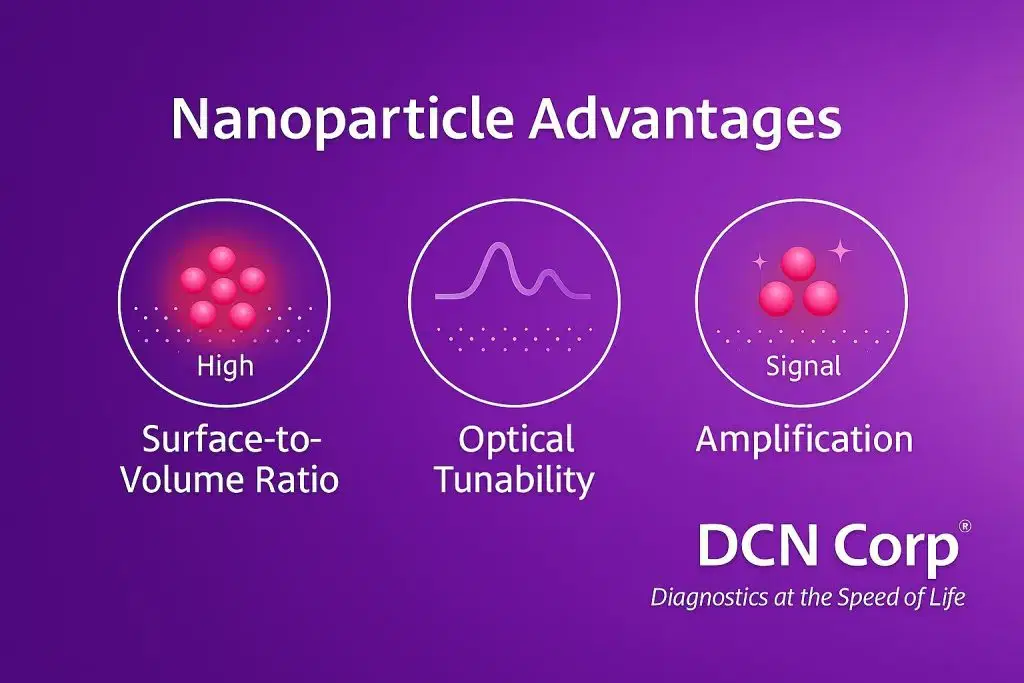
High Surface-to-Volume Ratio
Nanoparticles possess extremely high surface-to-volume ratios as long as there fabricated evenly at both a small and large-scale, which subsequently allows large numbers of biomolecules to bind to their surface. This property helps improve the probability of capturing target biomarkers and increases assay sensitivity.
Optical Tunability
Many nanoparticles exhibit tunable optical properties. AuNPs demonstrate strong plasmon resonance signals, while quantum dots produce stable fluorescent emissions. These characteristics enable highly sensitive optical biosensing techniques.
Signal Amplification
Nanoparticles can amplify diagnostic signals, allowing detection of extremely small quantities of biological molecules. This amplification improves limits of detection in many diagnostic assays.
In Summary: Sensitivity + Tunability + Amplification = Earlier, Clearer results.
Qualitative Power: Colorimetry & SERS (See the Signature)
Nanoparticles give us visually and spectroscopically rich ways to identify and detect biomarkers:
The qualitative benefits reduce ambiguity and speed triage, which is especially powerful in decentralised or resource-limited settings.
See how our 9c Protocol improves reproducibility for nanoscale coatings.
In Summary: Qualitative nano-signals help triage quickly and reduce ambiguity, especially in decentralised remote settings.
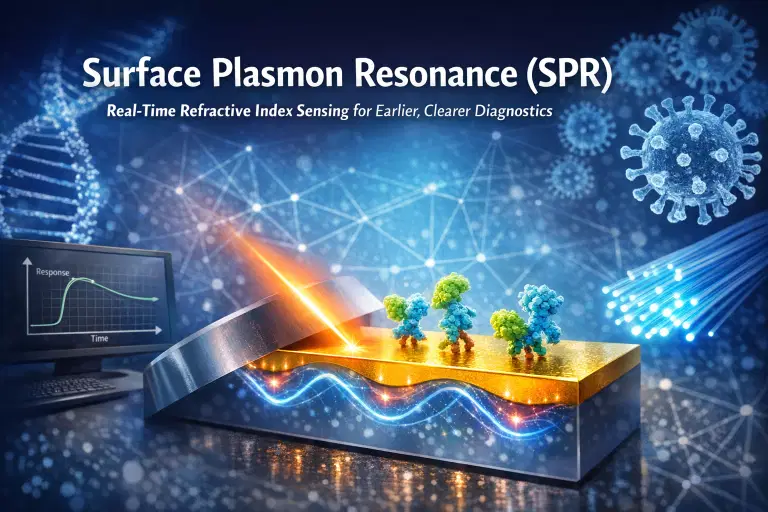
Quantitative Power: SPR/LSPR, Electrochemistry & Catalysis (Make It Measurable)
Beyond recognition nanoparticles are outstanding transducers for quantitative read-outs:
The dual features of qualitative and quantitative capabilities is what makes nanoparticles uniquely transformative for early detection tools and systems.
In Summary: Quantitative nano read-outs turn faint signals into numbers for triaging, staging, monitoring, and precise follow-ups.
From Promise to Practice: Engineering Realities
The available literature is clear: nanoparticle-enabled bio-sensing is progressing rapidly, and yet real-world deployment demands robust surface construction, reliable functionalisation, and mitigation of non-specific interactions and matrix effects. Movement towards miniaturised, integrated, microfluidic, and fibre/optical platform technologies continue, but success hinges on engineering surfaces that are repeatable, reproducible, and stable across multiple environmental conditions.
DCN Corp®‘s patent-pending 9c Protocol focuses on reproducible nano-coatings by controlling nanoparticle aggregation across a novel dip coating process technology, thus, supporting reliable, scalable performance at room temperature and pressure conditions with eco-friendly materials.
Where Nanoparticles Help Most
That is precisely why we invest in nano-surface controllability with the objective of increasing reproducibility and repeatability at the nanoscale. Nanoparticles can help most with:
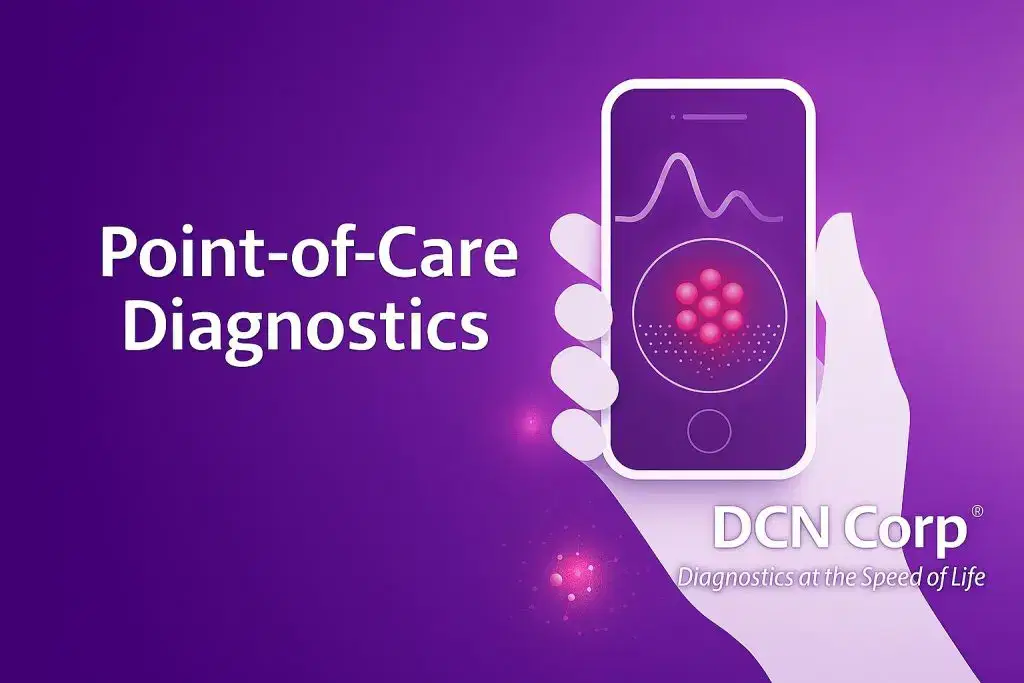
In Summary: The biggest wins are when earlier detection, richer context, and mass deployment is possible nearby the patient and in constraint remote settings.
DCN Corp® Approach (Surfaces First, Systems Always)
Join Us on the Journey
If you’re an R&D collaborator, clinician, investor, or healthcare system leader working on early detection, PoC innovation, or want to learn more about our purpose and mission – let’s explore how we can build this future together.
Have a collaboration idea or pilot study in mind?
Together, Let’s make faint signals clear.