Turning Faint Signals into Clear Answers
Every patient is unique, and ultimately the sooner we can see what’s happening, the faster clinicians can act with clarity and confidence. Nanoparticles help transform very faint biological signals into measurable ones both already at the laboratory bench and increasingly at the point-of-care (PoC).
Why Nanoparticles & Why Now?
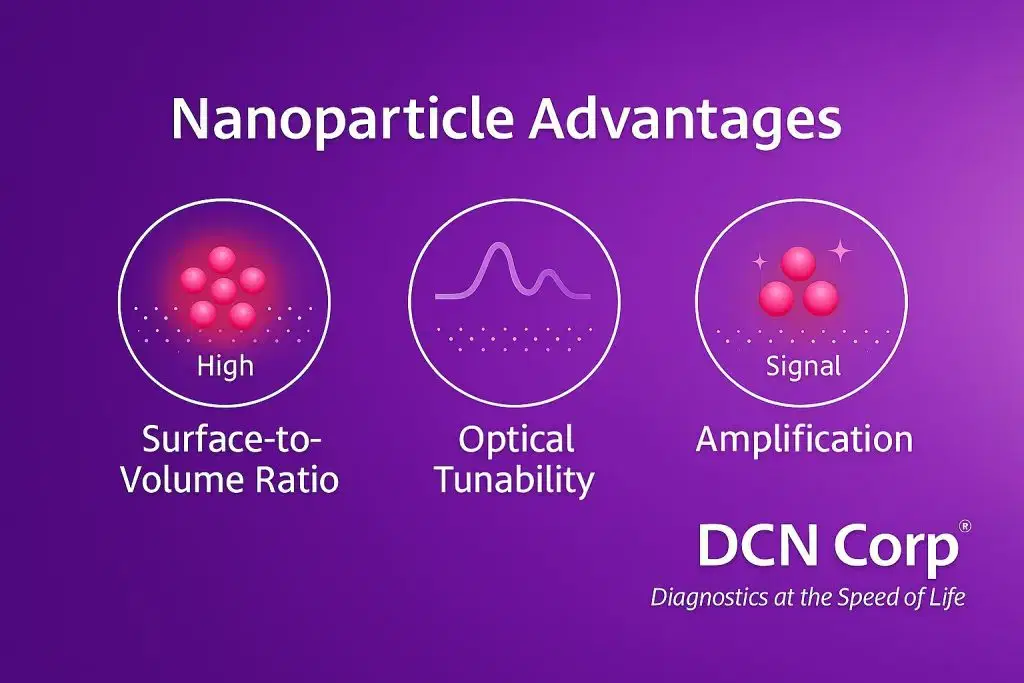
At the nanoscale, materials behave markedly differently. To that effect Nanoparticles offer the following unique benefits:
Together these advantages help markedly improve bio-sensing sensitivity and specificity, making nanoparticles central to next-gen diagnostics and therapeutics.
Recent reviews have shown how nano-biosensing platform technologies could span electrical, magnetic, mass-based, and photonic transduction. They also highlight a gradual shift towards array detectors that push into near-single-molecule regimes (with “digital” counting strategies) whilst recognising practical limits like diffusion and non-specific background, which is exactly the kinds of engineering realities DCN Corp® is working towards addressing.
Plain-English take: Think of nanoparticles as tiny antennas that boost weak biological signals so we can read them clearly.
Qualitative Power: Seeing Signatures that Matter
Nanoparticles give us visually and spectroscopically rich ways to identify and detect biomarkers:
The qualitative benefits reduce ambiguity and speed triage, which is especially powerful in decentralised or resource-limited settings.
See how our 9c Protocol improves reproducibility for nanoscale coatings.
Learn more about our approach: DCN Corp® Homepage.
Quantitative Power: Turning Signals into Numbers
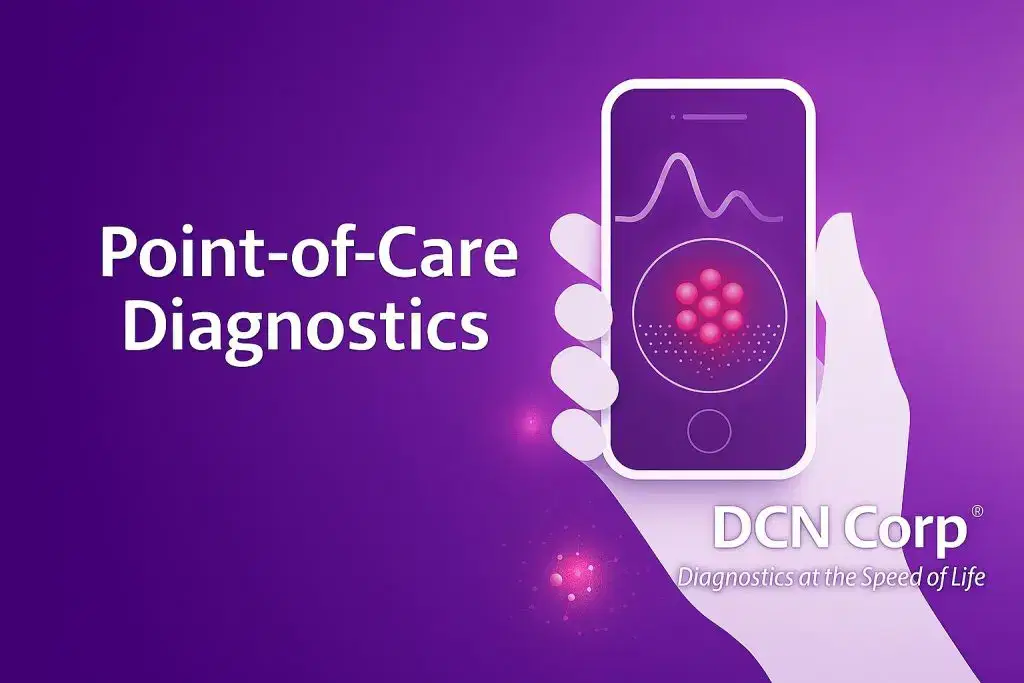
Beyond recognition nanoparticles are outstanding transducers for quantitative read-outs:
The dual features of qualitative and quantitative capabilities is what makes nanoparticles uniquely transformative for early detection tools and systems.
Plain-English take: Beyond a simple “yes answer”, nanoparticles let us count what’s there, which is helping track disease stages, treatment responses, and more.
From Promise to Practice: Engineering Realities
The available literature is clear: nanoparticle-enabled bio-sensing is progressing rapidly, and yet real-world deployment demands robust surface construction, reliable functionalisation, and mitigation of non-specific interactions and matrix effects. Movement towards miniaturised, integrated, microfluidic, and fibre/optical platform technologies continue, but success hinges on engineering surfaces that are repeatable, reproducible, and stable across multiple environmental conditions.
DCN Corp®‘s patent-pending 9 Combination (9c) Protocol focuses on reproducible nano-coatings by controlling nanoparticle aggregation across a novel dip coating process technology, thus, supporting reliable, scalable performance at room temperature and pressure conditions with eco-friendly materials.
Where This Heads to Next
That is precisely why we invest innano-surface controllability with the objective of increasing reproducibility and repeatability at the nanoscale. Imagine handheld or wall-mounted in-vitro diagnostic (IVD) bio-kits that deliver earlier and more precise answers. Ultimately improving patient wellbeing and resource allocation across multiple healthcare systems. That’s the vision and purpose guiding our R&D endeavours and potential partnerships.
Where DCN Corp® is focusing
Join Us on the Journey
If you’re an R&D collaborator, clinician, investor, or healthcare system leader working on early detection, PoC innovation, or want to learn more about our purpose and mission – let’s explore how we can build this future together.
Have a collaboration idea or pilot study in mind?
Start a conversation: DCN Corp® contact/collaboration page.
Or schedule time now: https://calendly.com/dcncorp-info/30min
Together, let’s build the future of earlier detection.