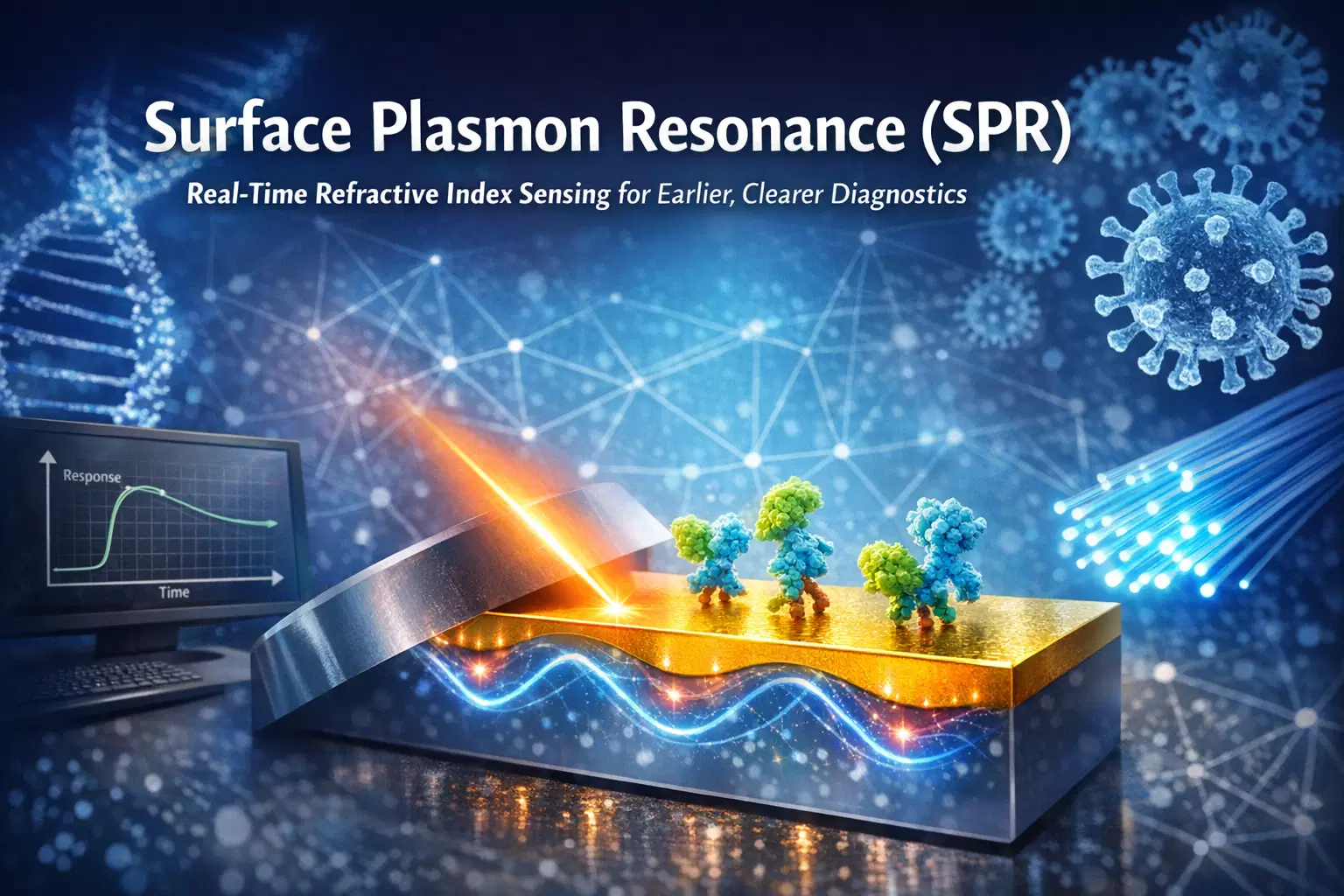
Real-Time Refractive Index Sensing for Earlier, Clearer Diagnostics
Executive Summary
What SPR does: measures tiny refractive index (RI) changes during binding at a metal interface in real-time and without a need for labelling.
Why it matters: clearer, faster, and decision-grade curve answers (association/dissociation, affinity) in complex samples nearby patient settings.
Where it fits: complements nanoparticle-enabled methods (colorimetric, SERS) with quantitative kinetics and decision-grade curves – see our Nanoparticles in Diagnostics overview for context.
Why SPR Matters Now in Modern Diagnostics
In our previous article we argued that diagnostics is moving from end-point read-out systems to a rapidly emerging requirement for real-time insights, which provides earlier detection, decentralised workflows, and more confident decision making workflows. SPR directly supports that shift by turning nanoscale binding into live refractive index (RI) curves that confidently what is happening, not just that it happened. For the broader nanoparticle context including SPR/LSPR please see our site pages on Nanoparticles and Nanotechnology.
What is SPR? A One-Paragraph Overview
Surface Plasmon Resonance (SPR) occurs when light couples with collective electron oscillations (also known as surface plasmons) at a metal-dielectric interface (typically a thin Gold (Au) film). When the molecules bind successfully nearby the surface, the local refractive index(local RI) changes, shifting the resonance. Tracking that shift over time yields a sensogram with association, steady-state and dissociation phases – providing kinetics and affinity without a need for fluorescent/enzymatic labels. This principality underpins both prism-based and fiber/planar implementations across both the research and applied diagnostic fields.
Key Idea: SPR helps convert successful binding into decision-ready curves – non-destructively, in minutes, label-free
How SPR Compares with Other Nano-Enabled Read-outs
SPR’s USPs make it ideal for modern day diagnostics:
Colorimetric Plasmonics – AuNPs, AgNPs, etc.: provide rapid Yes/No triaging, and simple end-user steps.
SERS: non-destructive, scalable, and label-free molecular fingerprints for specificity at minute concentrations.
Electrochemical nanostructures: high Signal-to-noise (S/N) current and voltage shifts.
SPR/LSPR: quantitative, real-time RI with kinetic insights, which is ideal to pair with SERS for unique identification and rapid colorimetric triaging. For an up-to-date eco-system viewpoint, please see our Nanoparticles in Diagnostics article.
Peer-reviewed studies highlight the growing sensitivity and consistently possible from plasmonic platform technologies; articulating how RI sensitivity is possible via well-engineered SPR nanostructures:
D-shaped fiber SPR with Gold (Au)/Zinc Oxide (ZnO) hybrids: modelled maximum RIS ~15,433 nm/RIU across RI 1.29-1.42 demonstrate improvement of semiconductor nanofilms that enhance field intensity at the junction.
Photonic crystal fiber (PCF) SPR designs report sensitivities in the ~9,000-10,000+ nm/RIU regime, with resolutions down to ~10-6 RIU.
Micro-grooved single-mode fibre SPR sensors: experimentally targeted biofluids, for example, haemoglobin solutions, across RI 1.33-1.41 with modelled sensitivity up to ~28,200 nm/RIU; illustrating the upside of careful mechanical and modal coupling designs.
Key Takeaway: Sensitivity is design-dependent, which is an advantage of SPR platform technologies because they can be easily tuned to clinical matrices and deployment constraints.
SPR in the Context of Nano-Enabled Diagnostics
In our recent nanoparticles (NP) article, we outlined how nanotechnology enhances both qualitative and quantitative diagnostic opportunities. Therefore, in that framework:
Molecular fingerprinting: SERS for label-free spectral sensograms as unique identifiers at minute levels.
Quantitative: SPR/LSPR for real-time RI curves; electrochemical nanostructures for high signal-to-noise current/voltage shifts; nanozyme catalysis for amplified signals and lower levels of detections (LOD).
Therefore, SPR’s sweet spot is in label-free quantitation plus kinetics, which complements colorimetric simplicity and SERS specificity. In platform technology terms, it can greatly help turn a faint binding event into a decision-grade time course to the point-of-care (PoC).
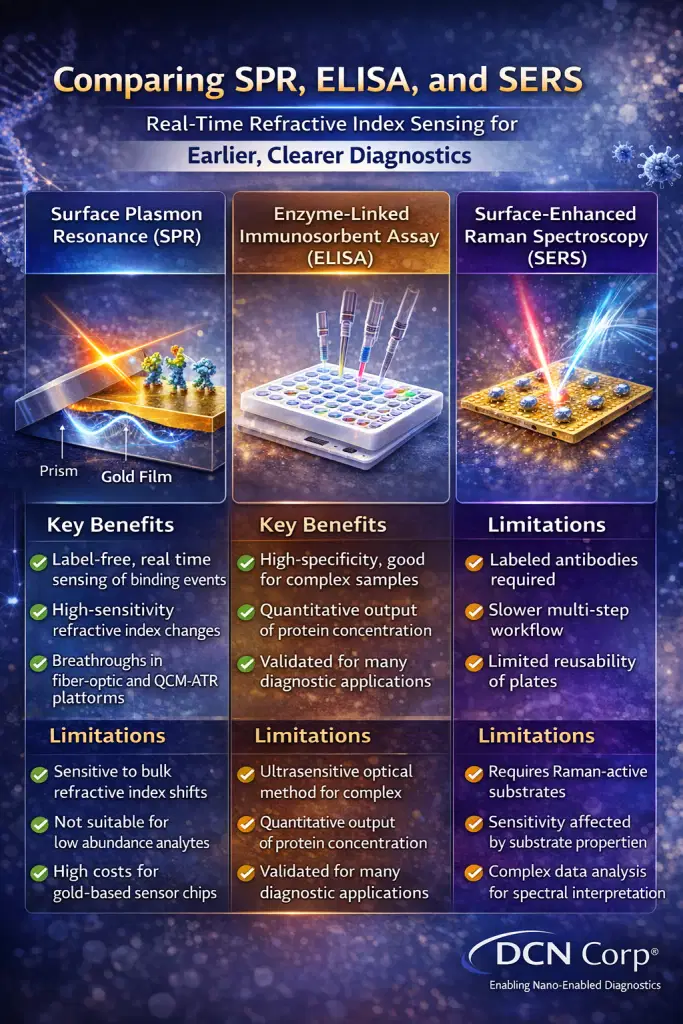
Comparison of SPR, ELISA, and SERS biosensing platform technologies for diagnostics
AntifoulingSurface Chemistry: real samples (blood, saliva, urine, etc) help introduce non-specific binding (NSB) sites. Coatings and controlled ligand density help protect kinetic integrity very useful for highly portable environments.
Mode Engineering& Field Confinement: hybrid interfaces as above-mentioned, and photonic designs enhance intensity where binding occurs helping drive sensitivity without sacrificing robustness.
Mechanical Robustness: micro-grooves or protective geometries on fibers help protect metallic layers whilst maintaining coupling for portable use.
RI Window Matching: ensuring to turn the sensor’s optimal RI range with expected matrices to help stabilise baselines and maximise dynamic range.
Infection & Host-response panels: multi-plexed ligand arrays evenly fabricated on SPR platform technologies or fibers, which can deliver rapid host-response snapshots and help positively inform treatment decisions.
Decentralised & Global Diagnostics: robust fiber/planar SPR modules paired with low-power optics are extremely promising for near-patient workflows, and aligns with DCN Corp®‘s purpose and mission for equitable and accessible diagnostics.
“Speed without clarity is unwanted noise. SPR helps deliver both.”
DCN Corp® Approach to SPR
Our 9 Combination (9c) dipping recipe is helping to translate across plasmonic coatings, other mechanical nano-scale dipping opportunities, and multi-modal read-out systems. Therefore, in the context of SPR we always focus on three pillars:
Stable, Repeatable & Reproducible Nano-scale Coatings for consistent baselines and sensograms.
Hybrid Plasmonic Stacks tuned to clinically relevant RI windows.
Multi-Modal Diagnostic Integration (SPR + SERS/colorimetry/electrochemistry) to combine quantitative depth with triage speed.
These objectives help build on our broader nano-enabled diagnostics roadmap, which is outlined across our website and social media posts.
The Road Ahead
SPR is not a gold standard technique yet, but when combined with NPs and a thoughtful system design, it helps close the loop from binding to decision.
As DCN Corp® continues innovating in nano-enabled biosensor platform technologies, SPR stands out as a primary technology helping power next era of fast, reliable, and widely deployable diagnostic systems.
Let’s Co-develop What’s Next
If you’re developing next-gen biosensors, diagnostic assays, or platform technologies and want to explore the benefits of SPR integration either stand alone and/or combined with other spectroscopic techniques, let’s connect.
SPR enables the tracking of changes in the local refractive index (RI) at a metal surface when a molecule successfully binds. The binding produces a measurable resonance shift (wavelength or angle) recorded in real-time as a sensogram.
SPR uses continuous thin film coatings (for example, Gold (Au), Silver (Ag)) and prism/fiber coupling; LSPR uses metallic nanoparticles that confine the field more tightly for compact arrays.
SPR is a non-destructive, label-free, increase efficiencies in steps and time, and provides kinetic parameters (ka, kd, KD), which is key for distinguishing specific binding from background and for quantifying interactions in clinically relevant environments.
Yes, with appropriate surface chemistry, reference subtraction, and temperature control. Fiber-SPR research studies have demonstrated that workable ranges are possible for physiological solutions.
Typically sensitivity depends on base substrate architecture and wavelength tunability.
From a few microlitres in a microfluidic chip technology to hundreds of microlitres in flow cells; fibre probes can operate with very small concentrations or in-line with sample streams.
The association phase rises when a bio-analyte successfully binds; the dissociation phase falls as it unbinds. Fitting these regions yields ka, kd, and KD (1:1 or more complex binding models).
Fiber-SPR and compact photonic approaches helps reduce footprints and subsequently power needs – promising for near-patient applications when paired with ruggedised optics and antifouling chemistries.
Glossary
The target molecule in a sample that the sensor or base substrate is designed to detect.
The strength of interaction between two binding partners; lower KD means tighter binding and vice versa.
Speed at which an analyte binds to the immobilised ligand.
Speed at which the complex falls apart.
RI of the sample solution whereby the changes cause baseline shifts unrelated to the surface binding.
RI is the immediate vicinity of the sensor surface where binding occurs.
Unit that expresses changed in the refractive index (RI).
Movement of the resonance wavelength/angle upon binding; reported as nm, deg, or instrument response units (RU) dependent on the platform technology.
Real-time curves demonstrating responses vs. time during association and dissociation phases.
Organic layer (often thiols on Gold (Au)) used to present ligands and reduce NSB.
Measure of response strength relative to baseline noise; higher is better.
How Nanoparticles enable earlier, clearer diagnostics-colorimetry, SERS, SPR/LSPR, electrochemical and catalytic readouts – plus design tips for real-world samples.
How earlier, real-time, nano-enabled diagnostics can support “United by Unique” for World Cancer Day 2026 (4th Feb): Equity, Earlier interception, and Faster, Dignified care.
Manage Consent
To provide the best experiences, we use technologies like cookies to store and/or access device information. Consenting to these technologies will allow us to process data such as browsing behaviour or unique IDs on this site. Not consenting or withdrawing consent, may adversely affect certain features and functions.
Functional
Always active
The technical storage or access is strictly necessary for the legitimate purpose of enabling the use of a specific service explicitly requested by the subscriber or user, or for the sole purpose of carrying out the transmission of a communication over an electronic communications network.
Preferences
The technical storage or access is necessary for the legitimate purpose of storing preferences that are not requested by the subscriber or user.
Statistics
The technical storage or access that is used exclusively for statistical purposes.The technical storage or access that is used exclusively for anonymous statistical purposes. Without a subpoena, voluntary compliance on the part of your Internet Service Provider, or additional records from a third party, information stored or retrieved for this purpose alone cannot usually be used to identify you.
Marketing
The technical storage or access is required to create user profiles to send advertising, or to track the user on a website or across several websites for similar marketing purposes.