Quick Summary
LSPR: A Foundational Technology for Next-Gen Ultra-Sensitive Diagnostics
Introduction
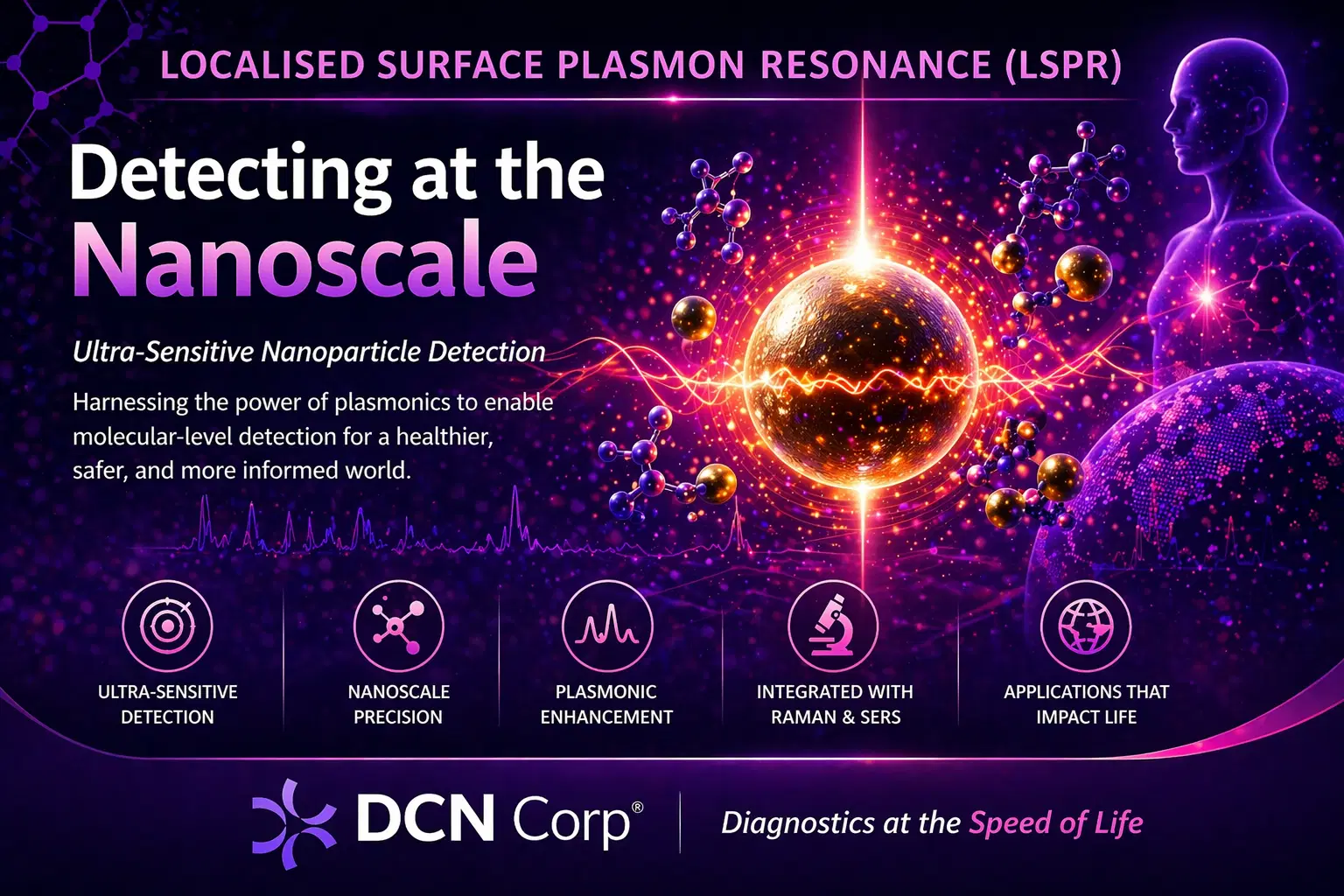
The ability to detect minute biological and/or chemical changes with high specificity and sensitivity is central to modern diagnostics and analytical sciences. Advances in Nanotechnology and other hardware platform technologies have significantly expanded what is optically measurable, particularly through the interaction of light with metallic nanostructures. Among the most impactful developments is Localised Surface Plasmon Resonance (LSPR), which is a nanoscale optical phenomenon that enables the detection of molecular-scale events in real-time.
LSPR arises when light interacts with metallic nanoparticles (NP), giving rise to collective electron oscillations and intensely localised electromagnetic fields. These type of nanoscale events enable sensors to act with extraordinary sensitivity, allowing sensors to detect binding events and chemical changes that would otherwise be undetectable using conventional optical techniques. As a result, LSPR based technologies have become a foundational mechanism for emerging biosensing, environmental monitoring, diagnostics, and spectroscopic detection technologies.
For organisations working at the intersection of nanomaterials, spectroscopy & sensing platform technologies, LSPR represents a key scientific foundational pathway for next-gen detection platform technologies.
What is LSPR?
LSPR occurs when conduction electrons in metallic NPs – typically Gold (Au) or Silver (Ag) – collectively oscillate in response to the incident light and its wavelength. At specific wavelengths, the frequency of the incident light matches the natural electron oscillation frequency, producing a strong resonance effect.
The by-product of the resonance leads to:
Because the plasmonic field signal can decay over only a few nanometers from the NP epicenter, even single-layer molecular interactions can induce measurable resonance shifts, thus, enabling detection at very low concentrations.
Physical Basis of Plasmonic Nanoparticles
Metallic NPs and their LSPRs have been known for decades to exhibit unique optical and qualitative properties, which arises from due to the collective behavior of their free electrons within metallic nanostructures.
As long as the ideal resonance conditions are met the following is possible:
- Incident photons smoothly interact with the conduction electrons
- The electrons oscillate coherently around the NPs
- A localised electromagnetic field forms around the NP interface
These intense fields are typically referred to as plasmonic “hotspots.”
The quality and intensity of a resonance wavelength depends on several factors, and the main ones are:
LSPR vs Conventional Surface Plasmon Resonance (SPR)
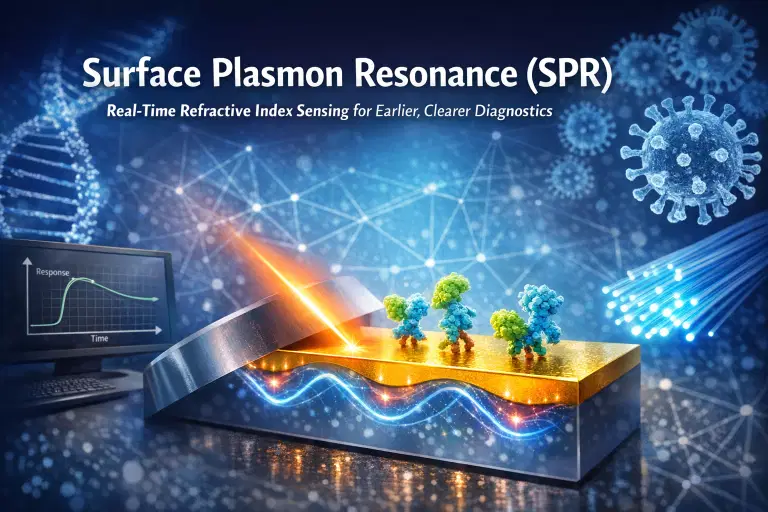
Whilst LSPR shares similar physical principles with SPR, the two nanoscopic phenomena differ significantly in their sensing mechanisms:
|
Feature |
LSPR |
SPR |
|
Plasmon type |
Localised oscillations in the NPs |
Surface waves on thin metal films |
|
Sensor structure |
Metallic NPs or nanostructures |
Continuous metal film |
|
Field range |
Tens of nanometres |
Hundred of nanometres |
|
Sensitivity |
Local molecular interactions |
Bulk Refractive index (RI) |
Because LSPR fields are more tightly confined, they can be very useful for detecting molecular-scale interactions close to the NP surface.
This unique property makes LSPR highly attractive for chemical sensing and biosensing platform technologies.
LSPR Sensing Potential Applications
The sensitivity possible from plasmonic NPs enables a wide range of potential sensing application, which can include:
Biosensing & Diagnostics
LSPR sensors can detect biological interactions such as
When biomolecules attach to functionalised NPs, the local refractive index (local RI) changes can cause measurable shifts in the plasmon resonance signal.
Environmental & Chemical Monitoring
LSPR-based sensors can detect contaminants at extremely low concentrations.
So, the applications can include:
Because these type of measurements can often be performed optically and in real-time, these systems are attractive for rapid screening platform technologies.
Chemical Detection
NP plasmonics can also enhance optical signals quite nicely when used in chemical identification. In particular, LSPR plays a key role in signal amplification mechanisms used in advanced spectroscopic techniques.
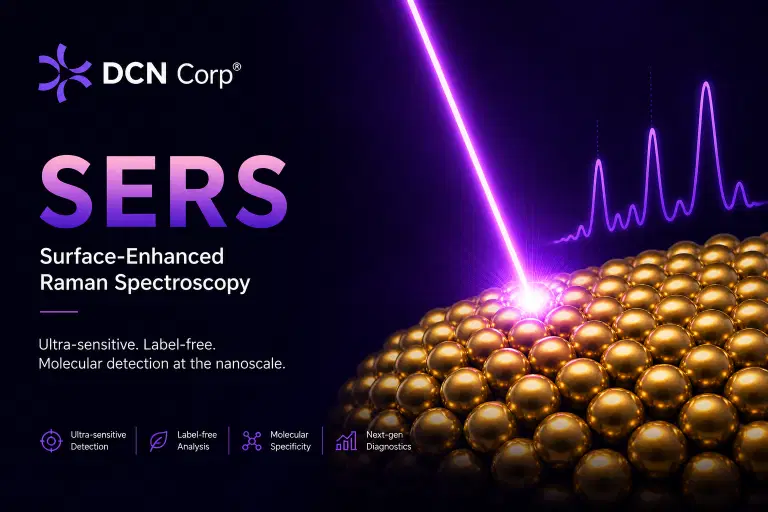
One obvious example and in fact a by-product is SERS whereby the plasmonic “hotspots” dramatically amplify the Raman signals.
Connection Between LSPR & SERS
DCN Corp® thinks one of the most powerful applications of LSPR arises when plasmonic base substrate nanostructures are combined with Raman spectroscopy.
In conventional Raman spectroscopy, scattered signals from biomolecules are often weak. However, when the biomolecules are located near plasmonic NPs, the localised electromagnetic field generated by the LSPR can enhance Raman scattering by several orders of magnitude.
This overall effect forms the basis and fascination of SERS sensing platform technologies, which can in turn achieve extremely low detection limits.
This enhancement enables:
Finally, because of this synergy, research into plasmonic nanostructures and to that effect Raman spectroscopy continues to expand across multiple scientific disciplines.
Advantages of LSPR Sensing Platform Technologies
LSPR-based biosensors offer several advantages when compared to traditional detection techniques (mainly without surface and optical propagation).
All the above-mentioned attributes make LSPR attractive for present and future portable sensing technologies and next-gen analytical tools and kits.
Future Directions in Plasmonic Sensing
As Nanotechnology continues to advance, LSPR biosensors are likely to play an increasingly important role in next-gen detection technologies.
Future key research directions include:
So, the convergence of plasmonic nanostructures and advanced spectroscopic techniques is expected to yield highly sensitive tools and kits capable of detecting trace quantities of both chemical and biological materials.
Let’s Co-develop What’s Next
If you’re developing next-gen biosensors, diagnostic assays, or platform technologies and want to explore the benefits of LSPR integration either stand alone and/or combined with other spectroscopic techniques – Let’s connect.
Ready to explore LSPR-enabled diagnostics?
Book a 30-min Discovery Call: calendly.com/dcncorp-info/30min.