Introduction
One of the core challenges in modern day diagnostics and sensing is not detection limits itself, but being able to detect reliably over a prolonged time at very low concentrations.
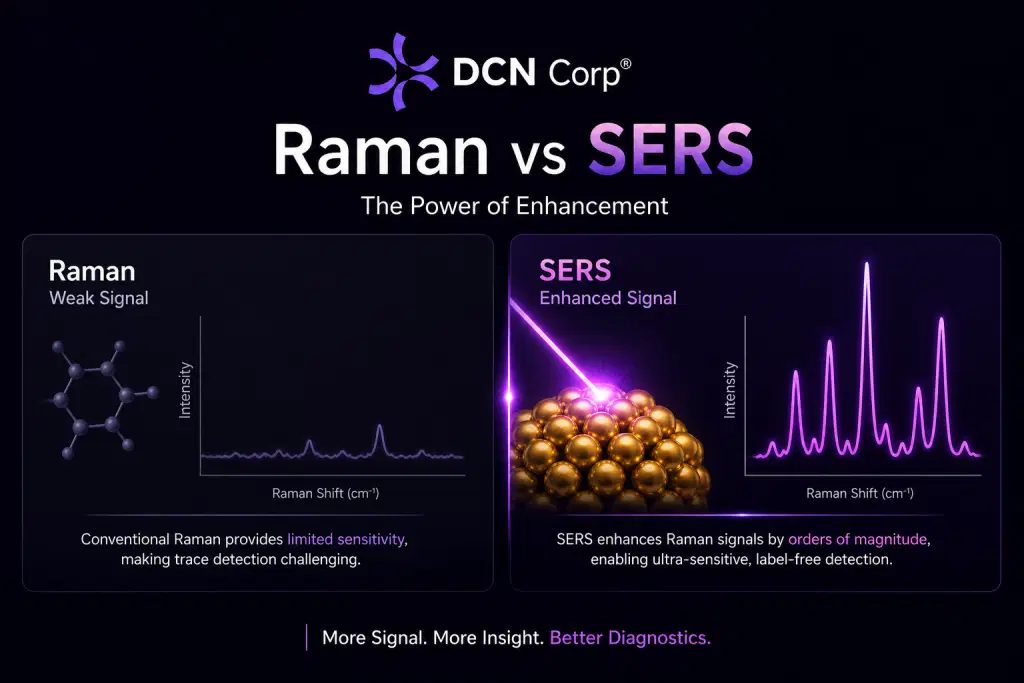
Conventional Raman spectroscopy provides powerful molecular identification data and/or information through vibrational signatures, but the resultant signals are inherently weak.
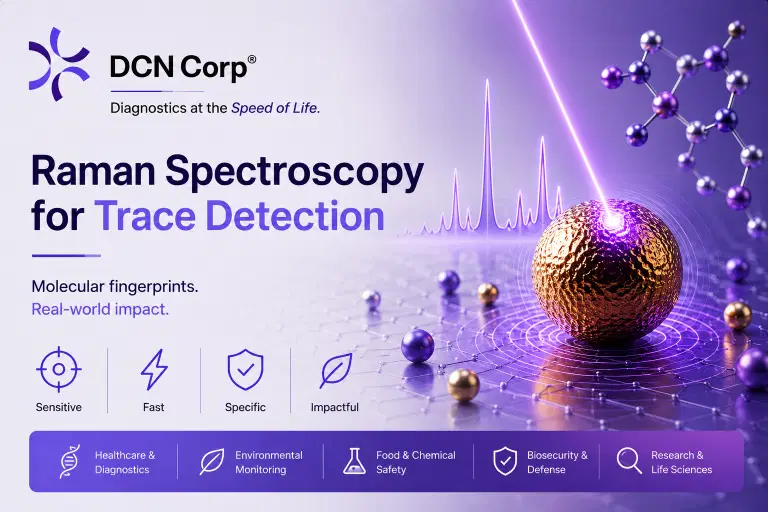
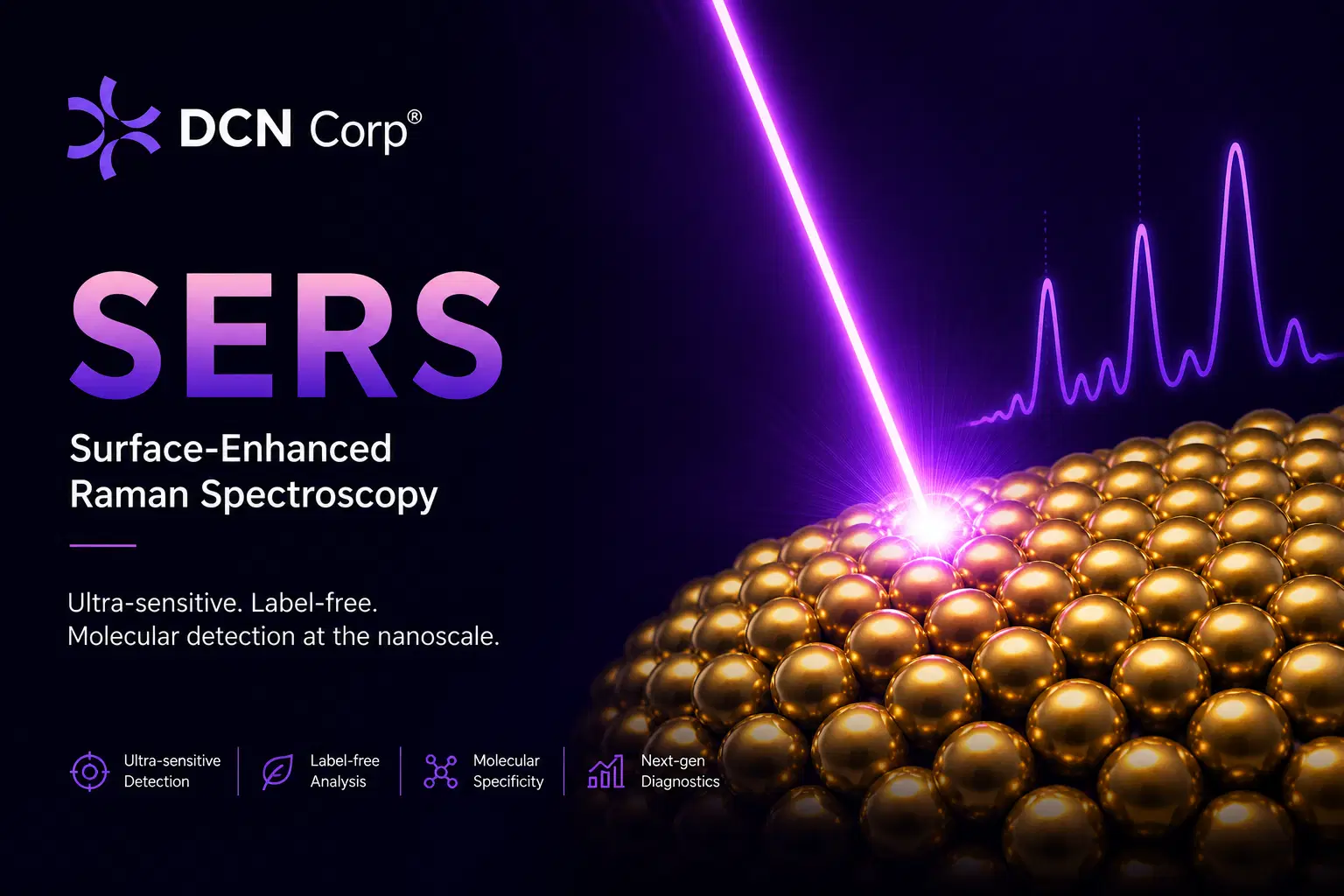
Surface-Enhanced Raman Spectroscopy (SERS) aims to address this historical limitation by leveraging the benefits of plasmonic nanostructures to amplify Raman signals, thus, enabling detection at trace and ultra-trace levels. Building on the amplification phenomena of Localised Surface plasmon resonance (LSPR), DCN Corp® believes SERS represents a critical step towards next-gen detection and preventive platform technologies.
What is SERS?
SERS is a spectroscopic technique in which Raman scattering via a base substrate coating is significantly enhanced when biomolecules are located nearby nanostructured metallic surfaces, typically Gold or Silver nanoparticles (Ag/AuNP). This enhancement by-product can increase signal intensity by several orders of magnitude, enabling detection of extremely low concentrations that would otherwise be difficult to observe.
How SERS Works
The mechanistical effectiveness of SERS arises from two well known mechanisms:
Why SERS Sensitivity Matters
SERS enables an iterative shift in focus in how detection problems are approached and subsequently diagnosed.
Rather than asking “Can we detect this molecule?”, the question nowadays becomes:
“How early and how precisely can we detect it?”
And SERS unique advantages include:
SERS vs Conventional Raman spectroscopy
|
Feature |
Raman Spectroscopy |
SERS |
|
Signal strength |
Weak |
Strong |
|
Sensitivity |
Moderate |
Very high |
|
Detection limit |
Higher |
Ultra-low |
|
Application focus |
Bulk analysis |
Trace-level detection |
Potential Applications
SERS is being explored across:
Nanoscale Engineering SERS Base Substrates
The performance levels of SERS base substrates depends strongly on NP design as well as other key parameters including:
Careful controllability of the factors above is essential for achieving reproducible, repeatable, and high-sensitivity measurements.
From Plasmonics to Platform Technologies
SERS is not just a technique, some classify it as a platform enabler.
This is because it is possible to integrate:
SERS supports the development of next-gen sensing systems capable of rapid, sensitive, and potentially field-deployable detection systems.
Closing Remark
SERS represents a major advancement in molecular detection systems. Ultimately by harnessing plasmonic effects at the nanoscale, SERS enables sensitivity levels far beyond conventional approaches. Therefore, as Nanotechnology and spectroscopy continue to converge, SERS some speculate is poised to play a central role in ultra-trace detection and precision diagnostics.
To that effect at DCN Corp®, we continually exploring how these technologies be they in a platform or non-platform format can be combined to enable next-gen diagnostic and sensing systems.
Finally, this topic is also discussed in this month’s LinkedIn Newsletter exploring the broader transition from Plasmonics to Precision diagnostics.