Introduction
As sensing and platform technologies continue to evolve, the challenge is no longer simply whether analytes can be detected. Increasingly, the scientific and manufacturing challenge is:
This is why Raman spectroscopy continues to attract regional and global scientific and commercial interests. Essentially by enabling molecular-level identification through light scattering, Raman spectroscopy offers a powerful analytical approach capable of generating unique molecular “fingerprints” without requiring fluorescent or chemical labels.
Subsequently, when smartly combined with Nanotechnology and plasmonic enhancement techniques such as Surface-Enhanced Raman Spectroscopy (SERS) – Raman-based systems may help push detection capabilities far beyond conventional analytical limits.
As a result, Raman technologies are increasingly being explored across diagnostics, environmental monitoring, chemical sensing, and ultra-trace detection applications
Raman Spectroscopy
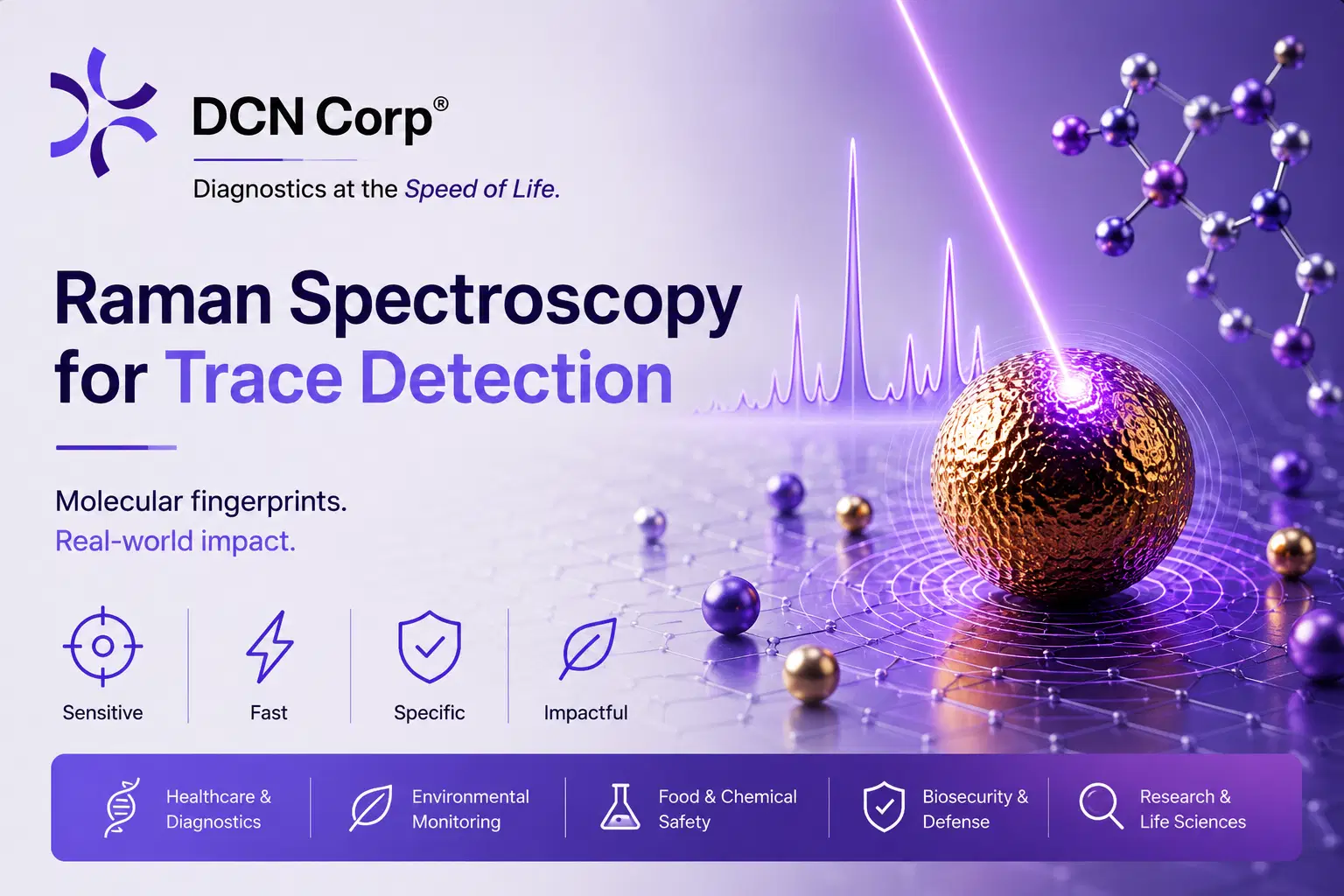
Raman spectroscopy is a vibrational spectroscopic technique based on the inelastic scattering of light, and when the incident photons interacts with molecules, most scattered photons retain their same energy. However, a very small fraction undergoes energy shifts caused by molecular vibrations. Traditionally this phenomenon is known as Raman scattering.
With Raman scattering every biomolecule exhibits an unique vibrational characteristic and spectrogram, which acts as a molecular fingerprint that helps identify chemical and biological substantces.
Unlike some conventional analytical approaches, Raman spectroscopy can often provide:
All these unique properties make Raman techniques particularly attractive for advanced sensing platform technologies and applications.
Why Conventional Raman Signals are Weak
Despite its advantages, conventional Raman spectroscopy has historically faced one major limitation: Weak signal intensity.
Only a small proportion of photons undergo Raman scattering, meaning signals can become difficult to detect at very low concentrations.
As an analyte concentration decreases:
This limitation has driven substantial research into signal enhancement strategies capable of improving Raman sensitivity.
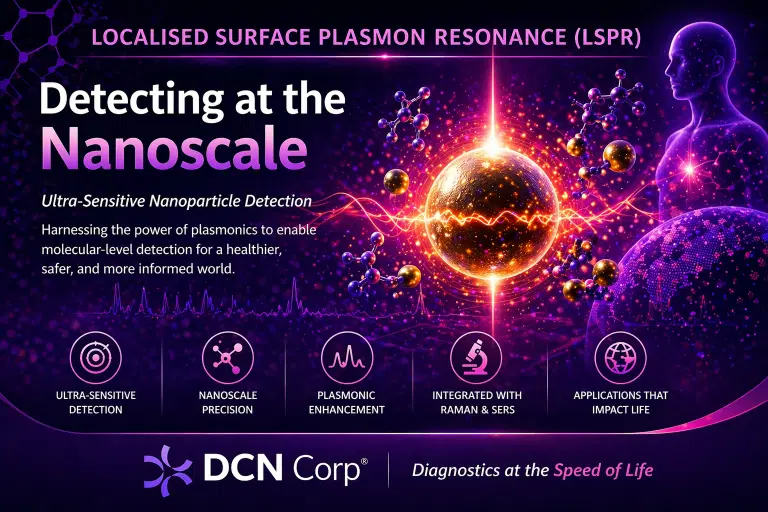
An Integrated Eco-system: Raman Spectroscopy, SERS & LSPR
Raman spectroscopy, SERS, and LSPR should not be viewed as isolated techniques/technologies. In fact, they form part of a broader sensing and platform technology eco-system build around:
The smart integration of the eco-system above, is becoming increasingly important for next-gen sensing and platform technologies.
Whilst Raman spectroscopy provides molecular specificity, SERS improves sensitivity, and LSPR contributes nanoscale electromagnetic enhancements.
Together, these approaches enable sensing systems capable of detecting extremely small molecular changes with increasing precision.
Potential Applications of Raman-based Detection Technologies
Diagnostics
Raman-based sensing technologies are increasingly being explored for finger print read-outs in areas of:
The capability to perform label-free molecular identification may support earlier and more precise diagnostic workflows.
Environmental Monitoring
Raman and SERS systems may enable sensitive detection of:
Portable Raman systems are also attracting interest for field-deployable environmental sensing.
Chemical Detection
Raman techniques and systems are widely used for chemical identification because of their molecular specificity. Applications can include:
Ultra-trace Detection
One of the most promising areas of development is ultra-trace sensing and detection.
Subsequently, through plasmonic enhancement and nanoscale engineering, SERS-based systems and tools continue to push detection limits towards increasingly smaller quantities of the target molecules.
The Future of Raman-based Bio-sensing
The future of sensing technologies is likely to depend increasingly on:
To that effect Raman-based systems and tools are strategically well positioned to smartly evolve.
Emerging research directions include:
As Nanotechnology and plasmonic engineering continue to miniaturise and mature, consequently Raman-based approaches may contribute significantly towards nex-gen diagnostic and analytical systems and tools.
Closing Remark
Raman spectroscopy continues to play an increasingly important role in modern sensing and detection technologies. And by combining molecular specificity with plasmonic enhancement strategies such as SERS and LSPR, Raman-based systems and tools are smartly helping re-define what becomes detectable at ultra-low concentrations. Therefore, as sensing challenges continue to evolve, the integration of Nanotechnology, plasmonics, and spectroscopy may contribute toward increasingly sensitive, portable, and real-time analytical platform technologies.
Finally, at we are interested in how these chemical and physical foundational scientific principles may support next-gen diagnostics and sensing platform technologies designed around the three ‘S’ of Sensitivity, Speed and Specificity.