Most healthcare decisions begin with the requirement for unambiguous data/information.
This is whether identifying a critical or infectious disease, detecting a bio-marker or anti-gen, closely monitoring disease progression or determining an appropriate treatment pathway.
Patients, their families and clinicians all depend upon diagnostics information which is clear to enable timely and informed decisions.
When that information is accurate and delivered in a timely manner, diagnostics can enable earlier intervention, improve clinical decision-making and help contribute to better patient outcomes.
Conversely, when the data is inaccurate, inconclusive or delayed, the results can be markedly different.
That is why on 17th June annually World Patient Safety Day is celebrated, and DCN Corp® explores this inter-connected relationship in a manner of:
Diagnostic Accuracy and Speed is an integral part of modern patient safety
The 2026 campaign theme is “Safe care for non-communicable diseases“, which is organised by the World Health Organisation (WHO).
As healthcare moves towards earlier detection, de-centralised testing regimes, Point-of-Care (PoC) and Over-the-Counter (OtC) diagnostics there is an increased need for diagnostic technologies that deliver timely, reliable and reproducible information.
What Does Diagnostic Accuracy Mean?
Typically diagnostic accuracy describes how effective a testing regime or diagnostic method distinguishes between the presence and absence of a particular condition, bio-marker, anti-gen and/or biological characteristic.
Subsequently, there are two common performance metrics discussed:
However, DCN Corp® wishes to argue that modern day effective regimes of diagnostics involves more then sensitivity and specificity alone.
Additional performance metrics need to considered such as precision, reproducibility, bio-analytical selectivity, maximum and minimum of Limit of Detection (LoD), sample quality and robustness can all influence whether a diagnostics technology generates clean information that is clinically valuable.
This differentiator becomes very important as sensitive technologies enable scientists and researchers alike to detect biological and chemical signals at progressively lower concentrations. That is why detection singularly is not enough.
The resultant signal must also be substantially meaningful, reliable and reproducible.
Why Diagnostic Accuracy is a Patient Safety Issue
Unfortunately, an inaccurate diagnostic result can influence almost every facet of a patient’s healthcare journey:
If a testing regime produces inconsistent or ambiguous results; clinicians will require additional testing before reaching a final decision. Consequently, this can increase both the time required for diagnosis and the burden placed upon healthcare systems and tools.
The Relationship between Earlier Detection and Accurate Detection
The earliest possible detection point has been known to considerably improve healthcare outcomes.
Managing to identify and classify the disease/condition via a bio-marker before advanced symptoms develop can create opportunities for earlier clinical intervention and disease management.
But there is an important qualification:
Earlier detection must also be an accurate detection mode
As diagnostic technologies increasingly become capable of identifying minute quantities of biological and chemical analytes, being able to differentiate a clinically relevant signal from background interference becomes important.
The Three S’s of SERS and Diagnostic Performance metrics
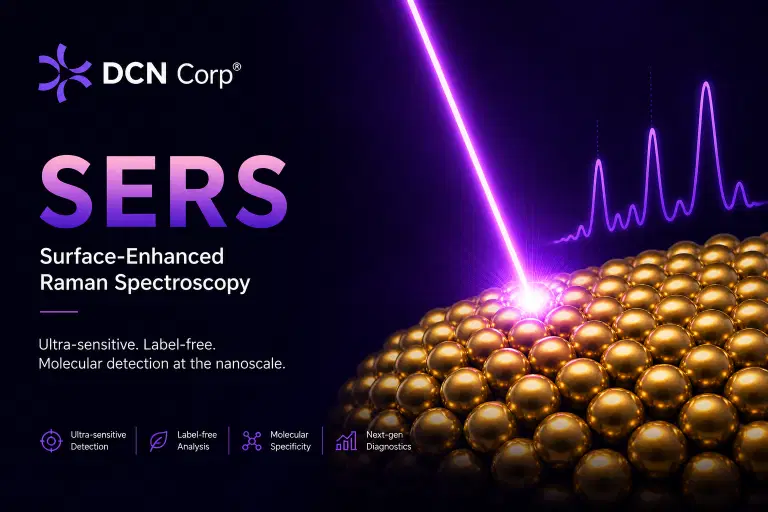
At DCN Corp® we believe that Surface-Enhanced Raman Spectroscopy (SERS) and diagnostics performance metrics through the prism of three inter-connected characteristics called the Three S’s:
Finally, there is another performance metric that connects all three above:
From Centralised Labs to Point-of-Delivery
Many well established diagnostics and clinical workflows depend upon the delivery back and forth to centralised laboratories, which contain sophisticated bio-analytical instrumentation and skilled personnel.
These types of systems and tools remain critical to modern medicine and diagnosis.
However, healthcare is gradually moving towards a form of de-centralised mode of testing, diagnosis, analysis and forecasting, respectively.
That is why PoC and/or Point-of-Delivery (PoD) diagnostics need to ensure to bring testing closer to the skilled end-user, the patient and their families in all environmental forms (including hospitals, clinics, pharmacies, community healthcare environments and potential other settings like in High-income countries (HIC)).
Faster accessibility to diagnostics information could reduce waiting times and help support earlier clinical decision making.
However, it should be noted that de-centralisation also introduces additional engineering requirements whereby PoC/PoD technologies may need to operate reliably with:
Therefore, managing to maintain diagnostic performance levels under these conditions is fundamental to translating promising science and laboratory technologies into safe and useful real-world diagnostic systems and tools.
How Nanotechnology could Support Sensitive Diagnostics
Nanotechnology will hopefully create new opportunities for smartly detecting biological and chemical interactions at minute scales.
At the nano-scale level; materials can exhibit unique properties related to optical, electrical and chemical outcomes that differ substantially from their bulkier counter-parts. These unique characteristics are particularly important in bio-sensing.
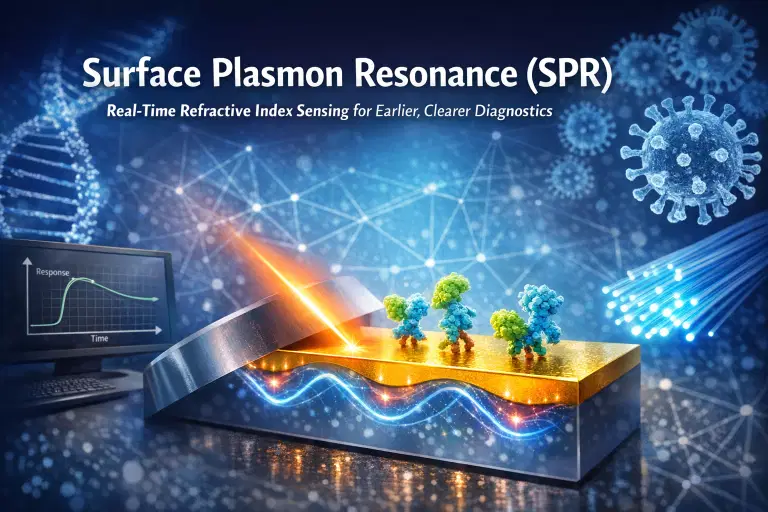
Metallic nanostructures like nanoparticles (NP) can interact strongly with light at different wavelengths through a phenomena associated with surface plasmons.
This has contributed to the continual development and investigation of platform technologies like:
These technologies continue to be investigated across modes in biomedical sensing, molecular diagnostics and bio-analytical sciences.
Their exciting potential lies not simply in detecting non-destructively smaller or weak signals, but increasingly in developing systems and tools capable of extracting useful bio-molecular data/information with high bio-analytical performance metrics.
Sensitivity Alone is not Enough
Naturally and especially in emerging diagnostic platform technologies there tends to be a focus on achieving the lowest possible Limit of Detection (LoD). LoD is undoubtedly important.
But it must be noted that exceptionally low detections does not guarantee a clinically valuable diagnostic platform technology.
Ultimately a viable technology must also demonstrate the following performance metrics:
All the considerations above help illustrate why translating diagnostics innovation from laboratory research into real-world deployments is markedly more complex than demonstrating a highly sensitive set of experimental results.
Building Trust in Next-Gen Diagnostic Platform Technologies
Healthcare professionals and patients worldwide need to feel confidence in the data/information being generated by existing and emerging diagnostic technologies.
Building that trustworthy confidence requires rigorous validation, quality and compliance management, regulatory approval and oversight and transparent evidence of performance levels.
As emerging technologies will increasingly involve nanomaterials, advanced optical bio-sensing, Artificial Intelligence (AI) and sophisticated data mining, analysis and Machine Learning (ML) techniques they will help move towards improved clinical applications and increased reliability. Therefore, innovation cycles and patient safety should not be viewed through the perspective of competing objectives.
That is why a well designed and protectable innovation can help strengthen patient safety by enabling diagnostic systems and tools that are faster, more sensitive, more accessible, more eco-sustainable, cost effective and finally more reliable.
All the considerations above help illustrate why translating diagnostics innovation from laboratory research into real-world deployments is markedly more complex than demonstrating a highly sensitive set of experimental results.
Looking Forward
The future of healthcare and to that effect diagnostics will depend upon our ability to detect conditions and/or diseases earlier which help make better informed clinical decisions.
Next-gen diagnostic platform technologies could help bring sophisticated bio-analytical capabilities close to the end-user and patients whilst reducing the time between sample collection and actionable data/information. But technological capability alone is not sufficient.
The future of diagnostics and equitable diagnosis must be built around accuracy, reproducibility, accessibility and trust.
That is why at DCN Corp® our continued pursuit in Nanotechnology, plasmonics and bio-sensory coatings is driven by the potential that advanced sensing platform technologies can contribute to the evolution of bio-molecular diagnostics.
World Patient Safety Day provides an important reminder of why that work truely matters.
The objective of diagnostics innovation is not simply to detect more; it is to generate clearer data/information earlier, so that better informed decisions can be made for patients and their families.
Earlier Detection > Greater Confidence > Better Decisions
Please note this blog has been published in support of the World Patient Safety Day, and it is intended for educational and informational purposes only and does not constitute medical opinion nor advice.